Jaanipäev Just what is Jaanipäev? Every year, around the longest day of the year, in June, Estonians will celebrate Jaanipäev. This word is translated as Jaan's Day or St. John's Day. The practice has been around for many centuries. The celebration includes gathering with friends and family to enjoy food and drink, singing songs of the homeland, maybe some folk dancing and of course, a bonfire. Some sources say that the bonfires of Jaanipäev were to commemorate the Kaali meteorite some 4,000 years ago. Over the years, this tradition has merged with Victory Day (June 23rd), which celebrated the defeat of German forces in the War of Independence in 1919. This year, we organized for the YSA group, a Jaanipäev party at the farm house of a dear friend here in Tallinn. This is a big deal here. It's bigger than Christmas. Most all the stores are closed and there are very few people downtown. During the buildup to Jaanipäev, the stores will advertise special meat for the festivities. It is called šašlõkk (pronounced shashlek). One store had 60 varieties. Meat lovers and grillers would be in heaven. We had 13 young folks show for the party and we all had a blast. Elder Allred was the designated šašlõkk griller and Sister Allred was the determined hostess to make everything real nice. After our meal, we went to the lower 40 and started the bonfire and, according to tradition, you must walk 3 times around the fire and then 3 times backwards around it to ward off bad luck for the year. To not light a bonfire is to invite destruction of your house by fire. Afterwards, we sang Estonian folk songs while our good friend accompanied us on the kannel, a stringed instrument. After a few rounds of singing, we engaged in the folk dancing which was very entertaining. Then came the jumping over the bonfire, a tradition that must be completed to ensure prosperity and good luck. Yes, yours truly, also jumped over it (we all could use some of that good luck, right?). This day is also important for lovers. In Estonian literature, there is a tale of two lovers, Koit (dawn) and Hämarik (dusk), who could only see each other only on the shortest night of the year when dusk and dawn occur at nearly the same time and could only exchange the briefest of kisses. It is customary for Estonians to seek out certain forest flowers (9 different kinds) and place them under their pillows hoping to dream of who they will marry some day. After all of the traditions were observed, we engaged in s'more making with 4 different flavors of chocolate (it's a big deal here, the chocolate). A fun time was had by all and as we headed home at 10:00 PM, the sun was still in the sky, trying to linger a little more, shedding its light on a happy day.
Farm house with green everywhere
The line forms quickly for the šašlõkk
Many people brought side dishes
My helper from Spain
My helper from heaven
Lighting the fire
And the singing begins
Privy with moose antler
S'more fixin's
Flowers of the forest
I hope she dreams of me
A fine group with the fire
Close up. Notice the traditional dress
Sunday, June 11, 2017
Break the Fast This is a widely used activity in YSA units all over the world. It's a great time to gather our single adults and provide a home cooked meal in a safe and inviting environment. This summer, we have seven BYU interns living here in Tallinn, so our turnout has been fabulous. From month to month, over the past year, we never know how many will come until we sit down to eat, and sometimes, we still don't know as others may come late. So we always make extra. It's really satisfying to see them interact and become more acquainted over a meal they didn't have to cook on a hot plate or a microwave. Sister Allred always makes the best dinners. Occasionally, we will have guest chefs come and prepare the meal. This month we enjoyed authentic Estonian cuisine made by one of our YSA sisters. It was a hit with everyone.
Enjoying our Estonian meal
The young Elders came too with an investigator
A Night at the Opera Well, not exactly. Some of our branch members are in a choir that was performing during the Old Town celebration week. We thought this would be a fun activity for the YSA group and so we made a plan to attend (free admission helps). It turns out that there were two choirs performing. These choirs are sponsored by various government agencies. The choir our friends are in is sponsored by the Politsei (police) and the other by the Tax commission. The Politsei choir had very nice uniforms and sang a variety of songs from classical composers to more modern. The Tax choir sang a number of movie theme songs from familiar Hollywood films. See if you can guess the tunes. At the end, both choirs sang together a song (Smile) written by Charlie Chaplin and used in his movie "Modern Times". The lyrics and title were later added by John Turner and Geoffrey Parsons.
Another Visit to the Open Air Museum The summertime activities have started and so we thought we would catch some of them at the museum ( Click here to refer back to our first visit in September, 2016). We hoped to attend a song fest of choirs representing various regions in Estonia where they would sing to each other (outside, of course) their favorite folk songs. I read the time wrong and we arrived just after it ended. So we wandered around the place and actually caught a song here and there. We bought a yearly family pass as we intend to come back several times this summer.
Who knew a kiik (swing) could be so fun
Things heard while on our path
These people love to sing
Sunday, June 4, 2017
District Conference
The District Conference is always a great time to meet up with friends and missionaries that live in other cities. This conference was really great as we had the Europe East Area President, President James Martino and his wife as well as our mission president and his wife. We also had a special visitor from Salt Lake. Sister Sharon Eubank, 1st C in the Relief Society General Presidency was on her first tour in that capacity. She was delightful and knows her stuff. This visit was dear for her as she once served a mission to Finland (right across the Baltic from us). Our Estonian daughter, Silva, was asked to translate for her. She was nervous, but she did great. We got to visit with her right after. Sister Allred gave her one of the Estonian flag hotpads that she makes for all the missionaries that serve in Estonia. Look close, she is holding it in the picture.
Translating is hard work in Estonian
Sis. Eubank speaking at the adult session.
Sister Allred, Sister Eubank and Elder Allred
A Walk Along the Shore
The other day, we went for a walk along the beach in Pirita. The sun was out but the wind was really trying hard to blow it away. It was so soothing and relaxing (if you can mentally cancel out the wind in your mind). The Baltic Sea is special. It is warmer (relatively speaking) because it is like an inland sea. Storms on the water are rare. With its ebb and flow, it harmonizes with the culture and the land, always bringing new life and color that is always on display.
A view of the Tallinn skyline through the trees
Sea enchantment and peaceful thoughts
A sailboat riding away from the shimmering sun
It's Old Town Days in Tallinn
It's tourist season here now with 18+ hour days, the streets are starting to fill up with tourists from all over. In Old Town, the craft vendors are out in force as well as many other attractions. One of the them is a medieval sparring contest made up of people who enjoy reenactment battles from the old days. Here is a short video I captured.
Sunday, May 7, 2017
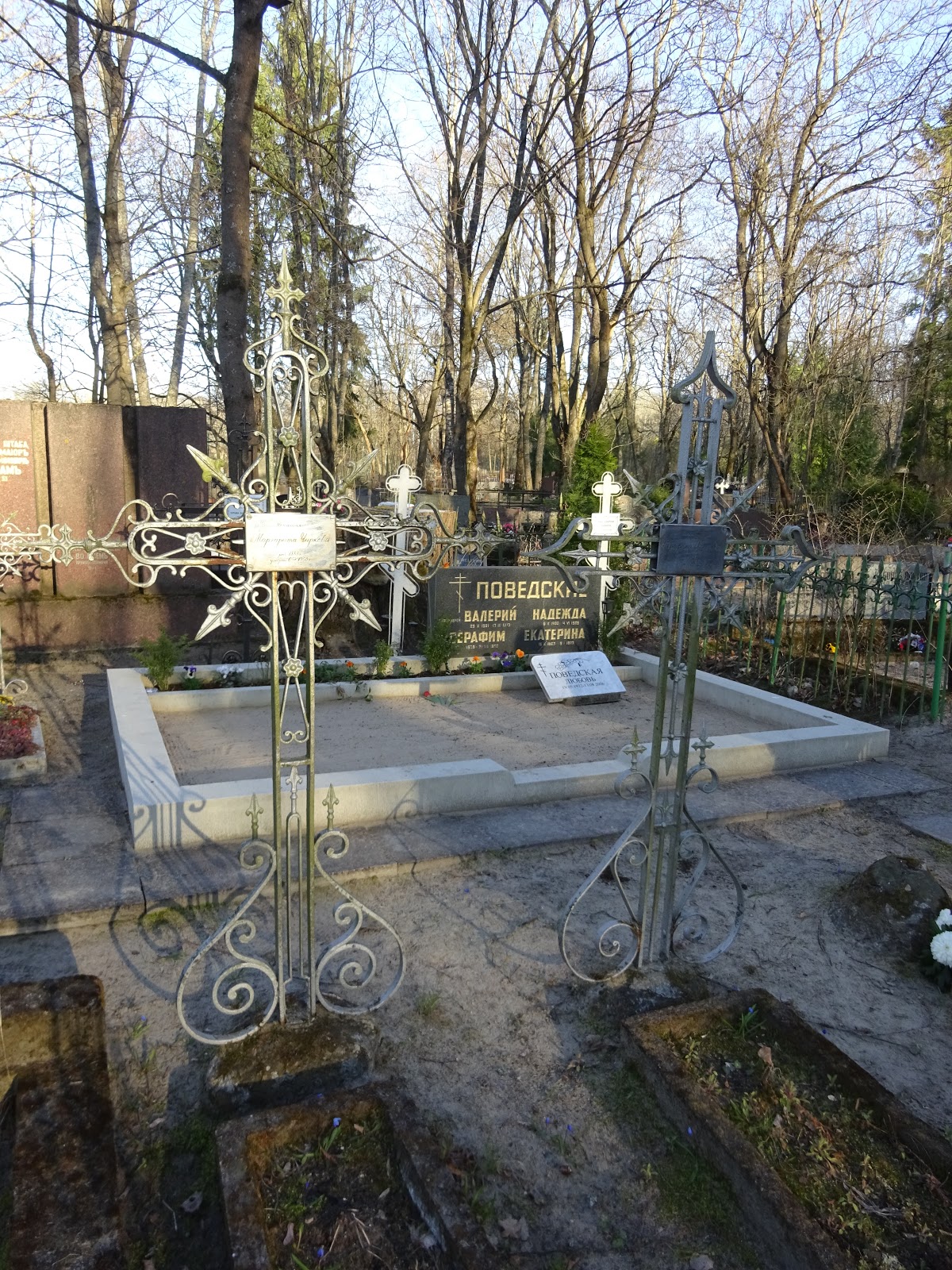
A Visit to a Cemetery Near where we live, right in town, is the Aleksander Nevsky Cemetery. It was founded in 1775 and is a treasure trove of history. just beckoning for discovery. We found it quite by chance one day as we were on a long walk. As we entered, we felt as if we had been transported to another time in the world - a time when things were very different and very simple. A place where culture played a large role in daily life, including the burial of the dead.
Main gate of the Aleksander Nivsky Cemetery
Closed to automobiles. To enter through the gate, you must walk through the small portal on the left
Many graves are placed in raised mounds like this one
Many graves are grouped within cast iron fencing
The crosses are usually very large and decorative
This gate was placed in 1908
All around us are the markings of the human race in dealing with their mortality. It is a somber place with many reminders that death is a portal we all must pass through at some time in our sojourn here on earth. The setting sun, see picture below, symbolizes the end of a mortal journey. Yet in the midst of death, there springs forth the hope of a better life, much like the hope of flowers that push their way through the wintered soil, reaching, ever reaching for warmth and life.
Spring flowers symbolize the hope we have in Jesus Christ for a new life, free from the pains and sadness of physical and spiritual death
Tire Change and Super Saturday in Riga Part 1. In April, when the snow is supposedly through for the winter, we are required to have the snow tires exchanged with the regular tires. This must be done in Riga, Latvia, as that is where the car is inspected and registered. It just so happened that the Super Saturday in Riga was going to be held the same weekend, so we decided to do both. Our faithful YSA here in Tallinn wanted to attend so the three of us drove to Riga on Friday. We have been to Riga several times, and each time we go, there is a "thing" that I've always wanted to stop and get a picture of because is was so unusual. This time, the sun was out. It wasn't raining or snowing. We stopped. I took the pictures. So, here is the backstory behind the "thing" I wanted to look at. In the 1700s, there lived a German baron by the name of Hieronymus Karl Friedrich, Freiherr von Münchhausen. Baron Munchhausen was a minor celebrity for his outrageous tall tales based on his military career. Upon hearing some of the stories told by Munchhausen, Rudolph Erich Raspe, a German writer, began to write magazine pieces about a character that was loosely based on the baron. He didn't even change the name. The real baron was a little upset, but couldn't sue for damages as Rudolph wrote the pieces anonymously. At one time in his career, the baron and his wife lived in Riga for a while. In his honor, there is a Munchhausen museum in the village of Vidzeme, Latvia, where the following pictures were taken. One of the many impossible tales told by Munchhausen was about his riding a cannonball while fighting the Turks. He rode the cannonball right into the Turkish palace and escaped unharmed. There are a few movies that have been made that depict this famous ride on a cannonball.
Part 2. After we checked in at the hotel, we went for a walk into the city to find some dinner. We stopped at a Chinese food cafe where we would choose our entree from one of several pre-cooked meats. Then they would place our order in the microwave to heat it up. I paid for dinner for four people and the total bill was less that 6 Euros ($6.50). We were ready for dessert and stopped at a French cafe and bought a box of colorful macaroons. I had never tasted these before. They practically melt in your mouth. So good!
But wait, dessert wasn't done yet. We went next door to Emils Gustavs, a chocolatier. The choices were just too hard to make with so many fine chocolate pieces to choose from. Sister Allred decided upon a large almond crumb cookie attached to a pure chocolate disc. She said it was heavenly. We found out that our treats evaporated as soon as we left the shop. How rude! We went on to view a few more places and then went back to rest for the night.
Sister Allred's almond-chocolate cookie
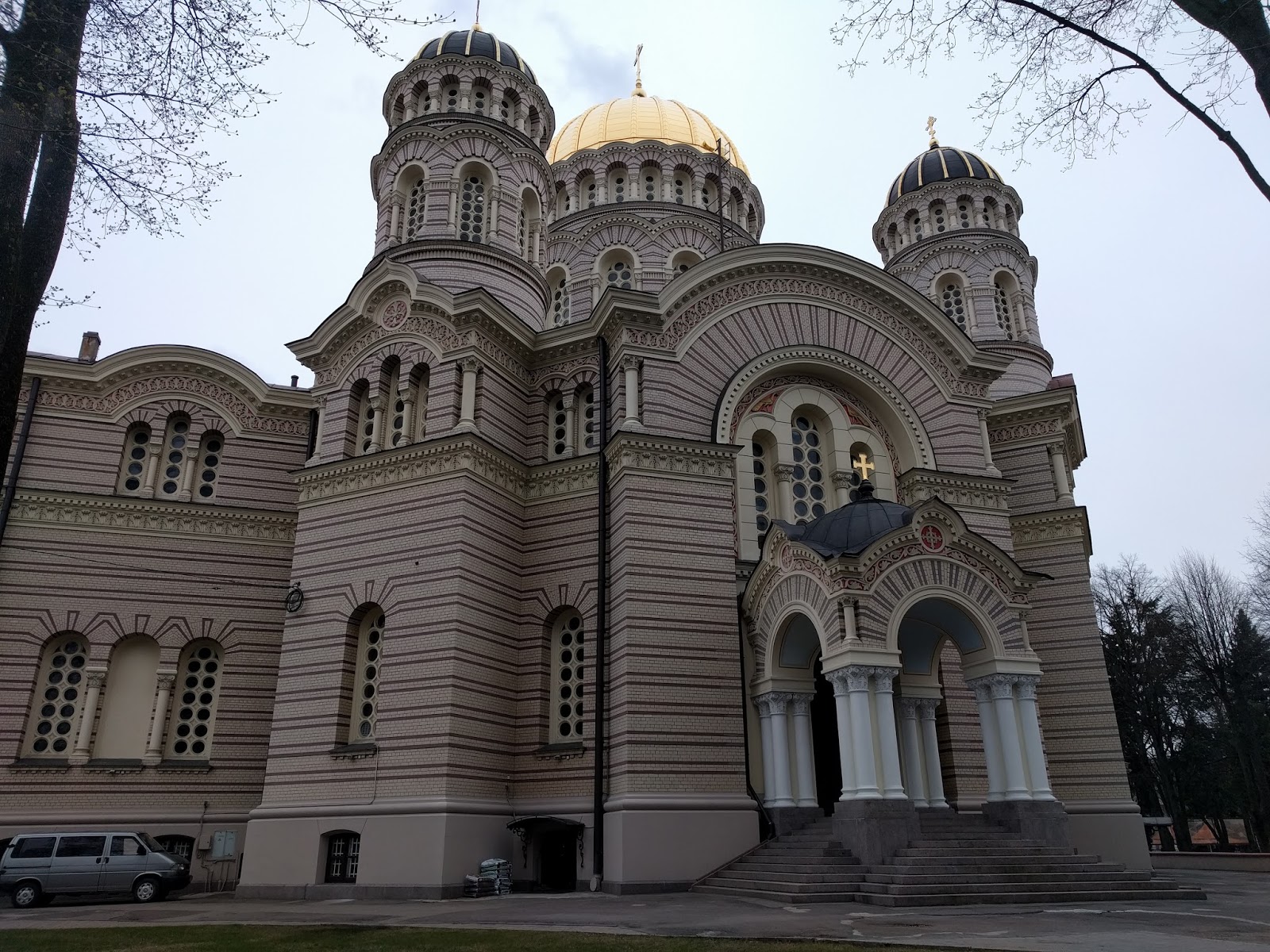
Riga Nativity of Christ (Orthodox church)
Another view
If you zoom in, you'll see the details
A yellow church
Part 3. Super Saturday was held in the new church building that was dedicated by Elder Ballard last year. It is like a stake center but not spread out like in the U.S.. This building has three levels with the chapel and cultural hall on the 2nd floor. Very cool. Before it started, we helped Elder and Sister Barnes prepare some of the fruit and vegetables for the lunch and set up chairs. The meeting was conducted by the YSA council and we had about 15 kids (included were 3 investigators) who attended. We heard a talk about prayer and communicating with God, then we had a demonstration on how to use the Gospel Library more effectively on our smart devices. We played some really fun games and then settled down for some taco salad (U.S. style) and homemade carrot cake. After lunch our CES Coordinator spoke to us about asking and listening to gain spiritual knowledge. The highlight of the day was attending a baptism for a YSA girl. It was all in Russian. Afterwards, we concluded with a short testimony meeting. We said our goodbyes and at about 4:30 PM and set our sights for Estonia and headed home. The funny thing about all this is that we had just changed out the snow tires on the car, and although it had rained all day in Riga, Estonia just had the worst blizzard of the winter/spring. The roads were all clear and we arrived home safe. The weather here can turn on a dime but I hear that tomorrow will be warmer . . . maybe.
Sister Allred being a "wobble wobble"
I call this the Evolution game. It was quite fun
The taco lunch line begins
We met a lovely girl from Kazakhstan
Sunday, April 23, 2017
Day Trip to Paldiski
Paldiski is a Baltic Sea port in north-western Estonia. Originally it was a Swedish settlement known as Ragervik in 1783. In 1962, Paldiski became a Soviet Navy submarine training base and hosted over 16,000 military personnel. They also built two nuclear reactors that were, at the time, the largest in all of the Soviet Union. Because of its importance, Paldiski became a closed city and completely closed off to civilians. After the collapse of the Soviet Union in 1991, the Soviets began to withdraw from Estonia and by 1994, Paldiski was reopened to civilians again. Left behind were several military barracks and other structures, some of which, have remained untouched to this day. The nuclear reactors were shutdown and decommissioned and the fuel was sent back to Russia. Paldiski is only a 50 minute drive from Tallinn and some people have found it much cheaper to rent there and commute to work in Tallinn on the train. Our main purpose was to allow Sister Allred to do her visiting teaching to a young family who recently moved there. The picture that follow are some of the things we saw there. We will go back again, I am sure.
The wind was very strong and about blew my hat off
The Paldiski shelf, it abruptly ends at the sea.
Lighthouse at the point
White caps on the Baltic
This Russian Orthodox Church
was originally built in 1851
but was recently renovated
Evacuation of Ingrid Finns
During the first months of the war between Germany and the Soviet Union (June 1941), Germany had conquered the greater portion of an area in Russia (around St. Petersburg) called Ingria. This area was inhabited by about 65,000 Finns. Because of famine, early winter and the ravages of war, the Ingrid Finns faced starvation. Not willing to supply food for the Finns, German authorities proposed to resettle the people back to Finland. Initially, Finland rejected the idea but later changed their mind by the end of 1942. By this time, Germany no longer agreed to the plan and agreed to send only 12,000 Finns. However, many more managed to escape and traversed through Estonia to refugee camps. One of these camps was in Paldiski. Conditions were harsh and about 2,000 Finns died there due to sickness in the camps. Eventually 63,000 Finns were resettled in Finland. After the armistice was signed in September of 1944, Finland was obligated to extradite the Ingrid Finns back to the Soviet Union. This memorial is to commemorate the Ingrid Finns who died here while waiting passage to Finland.
Memorial to Ingrian Finns
This house has no historical significance, we just liked it a lot
Sunday, April 16, 2017
Haid Ülestõusmispühi (Good Uprising Holiday) The Young Women of the branch put on a Easter celebration for the Primary children. They painted a larger than life mural of Christ and decorated the room with hidden eggs all around. After they heard the Easter story from Sister Allred, they each made a craft. Then the children ran throughout the building hunting for candy treats. And if that wasn't enough, they then put on their coats for a hunt outside. Afterwards, they served a berry wonderful cake for all to enjoy.